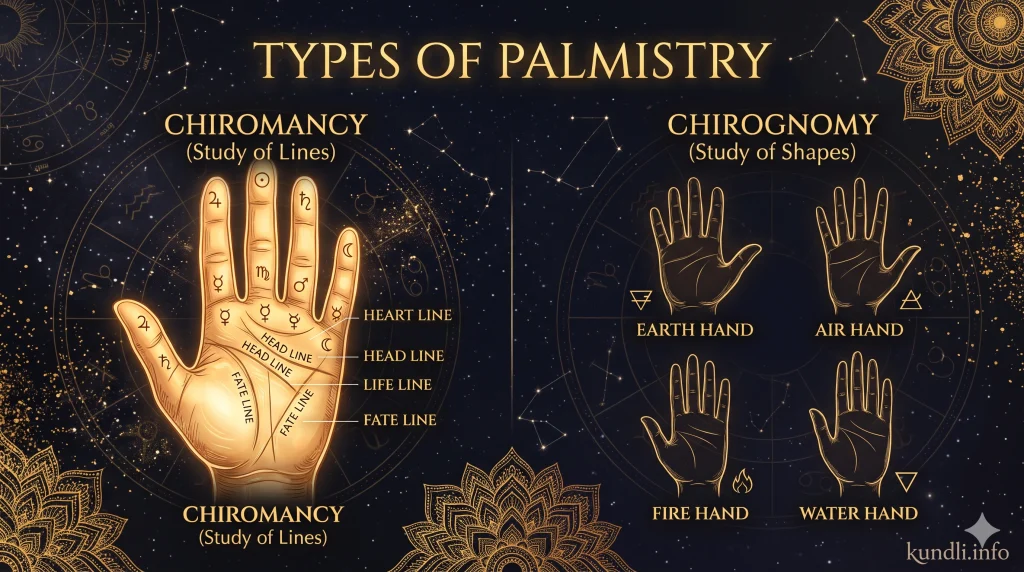
“The hand is the visible part of the brain,” wrote the physiologist Carl Gustav Carus — a line that practitioners of hand reading have borrowed for generations, because it captures exactly what the discipline attempts. This ancient practice, known as chiromancy palmistry, delves into the fascinating world of interpreting hand lines and shapes to provide insights into one’s future and personality.
The field splits into two halves. Chiromancy palmistry concerns the lines etched across the palm: their depth, length, breaks, and intersections. Cheirognomy concerns the architecture of the hand itself — the shape of the palm, the proportion of the fingers, the set of the thumb. The chiromancy vs cheirognomy distinction matters because shape is the canvas. A short, dense line reads differently on a broad, firm palm than on a slender, pliant one.
Chiromancy is the practice of interpreting the lines on the palm to understand individual traits and life paths, while Cheirognomy focuses on the hand’s physical structure to provide insights into personality. Recognizing the different types of palmistry, such as chiromancy and cheirognomy, is essential for a comprehensive understanding.
Most traditions also read both hands. The dominant hand records active life — decisions made, directions taken. The non-dominant hand holds innate potential. In contemporary Vedic consultations on career timing or marital compatibility, the gap between the two is often the reading.
The Four Elemental Hand Types in Palmistry
Modern hand types palmistry organizes the four types of hands around palm length and finger length. The elemental hand types—Earth, Air, Fire, and Water—are central to understanding the diverse characteristics in palmistry.
Earth hand palmistry describes a square palm with short, thick fingers — associated with practicality, physical competence, and a preference for tangible results over abstraction.
Air hand palmistry pairs a square palm with long fingers, read as intellectual restlessness, verbal fluency, and a need to analyze before acting.
Fire hand palmistry describes a long, rectangular palm with short fingers: kinetic, impulsive, drawn toward leadership and quick decisions.
Water hand palmistry combines a long palm with long, tapering fingers — the marker of emotional sensitivity, intuitive processing, and imaginative depth.
Palmistry categorizes hand types based on the elemental associations of Earth, Air, Fire, and Water, reflecting different personality traits and behavioral tendencies.
Finger Length and Fingertip Signatures
Classification depends on a clean measurement. Compare the palm’s width at its broadest point to its length from wrist crease to the base of the middle finger, then compare the middle finger’s length to the palm’s length. Fingers roughly equal to the palm read as long; noticeably shorter fingers read as short.
Fingertips refine the portrait. Conical tips suggest aesthetic sensibility; spatulate tips, restless invention; square tips, methodical reasoning; pointed tips, idealism.
The thumb anchors everything. Length signals willpower, and the angle of its backward flex signals adaptability versus stubborn resolve.
Traditional and Regional Systems of Palmistry
The major palmistry traditions developed independently and still disagree in useful ways. Understanding these regional differences enriches the practice of chiromancy palmistry.
Chinese palmistry reads the hand through the five-element cycle — Wood, Fire, Earth, Metal, and Water — rather than the four-element Western scheme. Each element carries a corresponding organ system and seasonal temperament, so a hand classified as Metal implies something about constitution as well as character.
Indian palmistry, known as Hast Jyotish and rooted in samudrik shastra palmistry, treats the hand as a subsidiary chart. Readings are cross-referenced against the natal horoscope, with planetary periods supplying the timing that lines alone cannot.
Western palmistry inherited a medieval mystical vocabulary and, across the twentieth century, converted much of it into psychological archetyping. By the 21st century, many Western practitioners describe their work as temperament profiling rather than prophecy.
The mounts illustrate this divergence plainly. A raised Mount of Venus signals vitality and appetite in Western reading; vedic palmistry ties the same elevation to the planetary strength of Shukra in the birth chart.
Hast Jyotish, the Indian system of palmistry, integrates hand readings with Vedic astrology, providing a holistic view of destiny through the lens of both hands and horoscopes.
What are the 7 Types of Hands in Classical Palmistry?
Before the elemental scheme dominated, classical Western texts used a seven-part taxonomy of palmistry types of hands — elementary, square, spatulate, conic, philosophic, psychic, and mixed.
The elementary hand palmistry category describes a thick, stiff palm with short fingers and few lines, historically linked to physical labor and instinctive response. The spatulate hand palmistry type flares at the base or the fingertips and belongs to builders, engineers, and inventors. Square hand palmistry indicates order and reliability; conic hand palmistry, artistic responsiveness; philosophic hand palmistry, knotted joints and analytical patience.
Psychic hand palmistry describes the rarest form — long, narrow, almost fragile. The mixed hand palmistry category is the most common in practice, where traits from several types overlap in one person.
Key Line Variations: Decoding the Fate and Heart Lines
Among the different types of palm lines, the Simian crease is the most discussed rarity: the heart and head lines fused into a single transverse furrow, read as intensity of focus and difficulty separating feeling from thought.
Types of fate line in palmistry are classified mostly by origin. A fate line rising from the wrist suggests an early-set direction; one rising from the life line suggests a career built through family support or self-effort; one rising from the Mount of Luna suggests a path dependent on public recognition.
A densely lined palm is not a flaw. It usually indicates nervous sensitivity and a highly active mental register.
Technical Deep Dive: Methodology for Hand Evaluation
A disciplined reading follows a fixed sequence, and reversing it produces errors.
Begin with texture. Coarse skin, fine skin, and the temperature and moisture of the palm establish the physical register before any line is interpreted. Then test flexibility — how far the fingers bend back, how the thumb opens, whether the palm resists pressure. Only then read the lines.
Skin consistency modifies the elemental verdict substantially. A firm Water hand expresses its sensitivity through disciplined creative output; a soft Water hand expresses it through mood and receptivity. The same logic applies across all four types of palm reading categories.
Next come the mounts, the padded elevations beneath each finger and along the palm’s edges. In Vedic traditions each corresponds to a planet, and their relative prominence maps planetary emphasis onto temperament.
The most frequent failure is ignoring context. Manual labor flattens mounts and scores the palm with incidental creases. Age thins the skin and softens definition. Reading those changes as character is a category error.
Palmistry by the Numbers: Statistical Observations
Practitioners frequently claim distribution figures — how often each element appears in a general population, how Air hands cluster in analytical professions while Fire hands cluster in sales, how often the Simian crease appears across demographic groups. These claims circulate widely and are rarely accompanied by a verifiable study, sample size, or methodology.
Treat them as practitioner folklore rather than data. Where a reader cites prevalence, the honest question is what population was counted, by whom, and under what classification rules. Absent those answers, the number carries no weight.
Is Palmistry 100% Accurate? Limitations and Considerations
No. The question itself misrepresents the discipline. Hand reading functions as a structured prompt for self-reflection — a vocabulary for describing temperament — not as a mechanism for predicting events with certainty.
The lines themselves suggest against determinism. Secondary creases appear, deepen, and fade across a lifetime as habits, stress patterns, and grip change. Whatever the hand records, it is not fixed at birth.
Ethical limits follow from that. Readings touching on marriage, fertility, or illness sit adjacent to medical and legal territory, and a responsible practitioner declines to cross the line. Different types of marriage lines on palm readings describe relational temperament, not a verdict on a specific partnership.
The schools also trade off against each other. Vedic practice offers timing through planetary periods but demands accurate birth data. Western psychological reading needs no birth chart but surrenders predictive specificity entirely.
When Hand Analysis Isn’t the Right Approach
When a question turns on timing — when to marry, when to change careers — a natal chart handles it better than the hand, which is weak on dates.
Significant hand injury, surgical scarring, or repetitive strain distortion can render classification unreliable; the physical record has been overwritten by circumstance.
And there is a difference between a practitioner working within a defined tradition and a party-trick reading. The former offers a framework for reflection. The latter offers a performance and should be enjoyed as such.
Key Takeaways: Summary of Hand Shapes and Meanings
- Start with shape, not lines. The four types of hands palm reading recognizes — Earth, Air, Fire, Water — establish baseline temperament. Every line is interpreted against that background, never independently of it.
- Rarity is not superiority. A psychic hand indicates particular sensitivity, not a superior destiny. The elementary hand indicates directness, not deficiency. Temperaments differ; they do not rank.
- Read both hands. The dominant hand shows what has been built; the non-dominant shows what was given. The distance between them is where the useful conversation lives.
- Lines require synthesis. Among the different types of hand lines, a long head line in palmistry reads as sustained analytical capacity on an Air hand and as prolonged rumination on a Water hand. Context governs.
- Treat it as complementary. Hand analysis in 2026 works best alongside other frameworks for personality assessment and personal development, not as a replacement for them.
Where to Look Next
Serious study moves in four directions: classical Sanskrit sources for the original definitions behind samudrik terminology; dermatoglyphics research for the biology of ridge formation; academic histories of divination for how these systems spread between civilizations; and a certified practitioner working in a named tradition, for the parts of hand reading that only direct observation teaches.